Spain Flips the Script
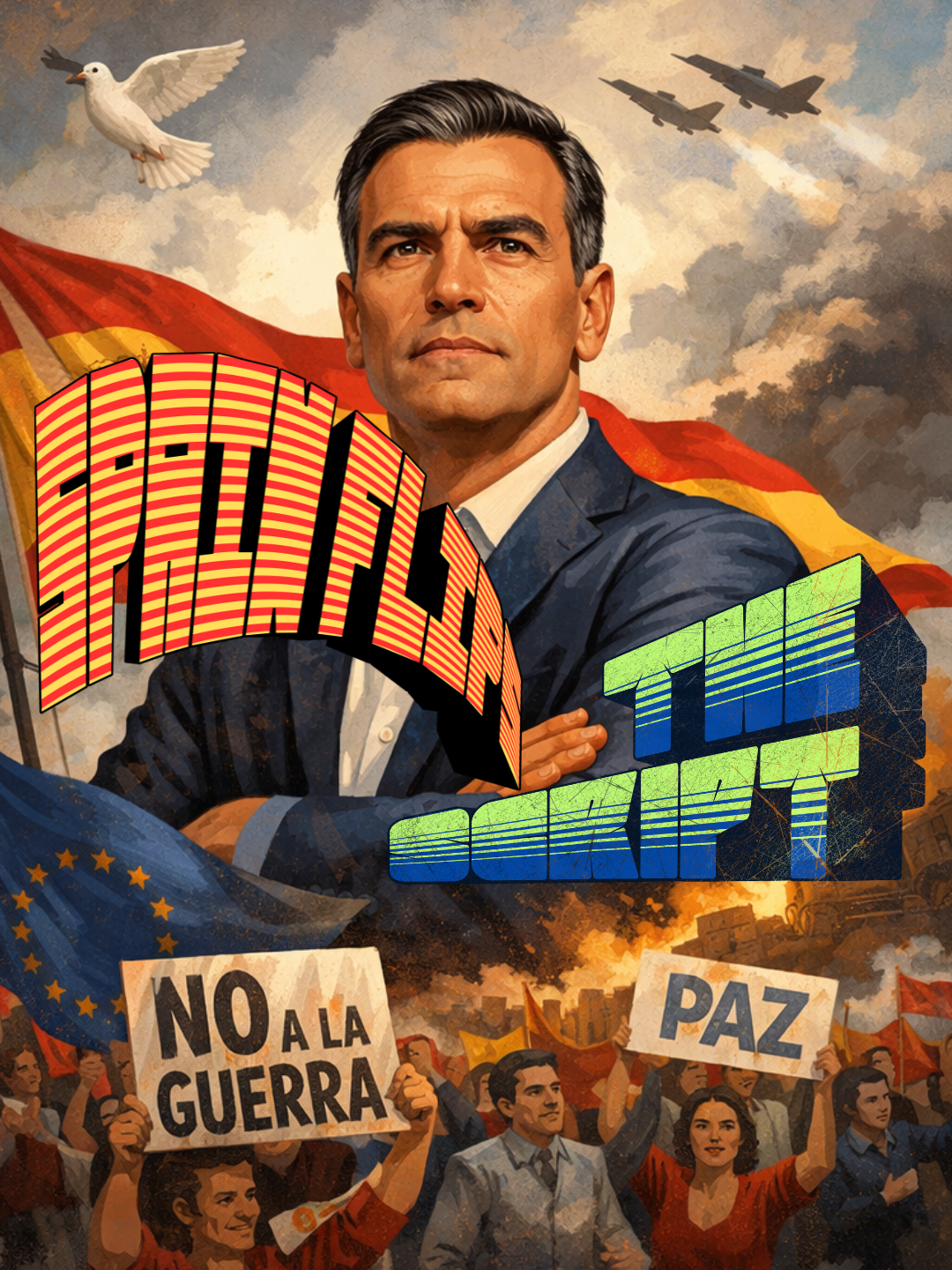
When Spain’s Prime Minister, Pedro Sánchez responded to calls—reportedly echoed by Israel’s Benjamin Netanyahu—for broader European alignment in escalating conflict, his words landed with unusual force: as long as he leads Spain, the country will not join any war. And more provocatively, that those who do are “cowards.”
It’s a statement that does more than reject a specific military invitation. It redraws a moral boundary in real time—one that challenges not just policy, but the psychology of alliances.
At one level, Sánchez is speaking to a domestic audience. Spain, like much of Europe, carries a long memory of wars that began with strategic logic and ended in human catastrophe. His stance taps into a deep political instinct across the continent: skepticism toward foreign entanglements, especially those that risk spiraling beyond control. In that sense, his refusal isn’t radical—it’s aligned with a broader European fatigue toward open-ended conflict.
But the language he chose—calling participants “cowards”—complicates everything.
Traditionally, refusing to join a war has been framed as caution, diplomacy, or restraint. Sánchez flips that script. He suggests that entering war, rather than avoiding it, may be the easier path—the one driven by pressure, fear of isolation, or the need to project strength. In his framing, it takes more courage to resist escalation than to participate in it.
That’s a striking inversion of political rhetoric. And it carries consequences.
First, it introduces friction within the European Union. The EU has long struggled to present a unified foreign policy, particularly on security matters. Some member states lean toward stronger military alignment with allies like the United States, while others prioritize neutrality or diplomatic engagement. Sánchez’s statement doesn’t just signal Spain’s position—it implicitly critiques those who might choose differently. That risks deepening divisions at a moment when cohesion is already fragile.
Second, it reshapes the narrative around leadership. In times of crisis, leaders are often judged by their willingness to act decisively, sometimes militarily. Sánchez is betting on a different metric: that restraint, even in the face of pressure, can be framed as strength. Whether that resonates beyond Spain depends on how events unfold. If escalation leads to prolonged instability, his stance may look prescient. If restraint is perceived as passivity, critics will be quick to reframe it as avoidance rather than courage.
Third, and perhaps most importantly, it raises a question about the future of deterrence and alliance politics. Modern alliances are built not just on shared interests, but on expectations of mutual support. When a leader publicly rejects participation—and morally questions those who don’t—it introduces uncertainty. Allies may begin to ask: who shows up, and under what conditions? And adversaries may test those boundaries.
Still, there’s a deeper layer to Sánchez’s remarks that goes beyond geopolitics.
In an era where AI, information warfare, and decentralized influence are reshaping how conflicts begin and spread, the threshold for “joining a war” is no longer as clear as it once was. Military engagement is just one dimension. Economic sanctions, cyber operations, and even narrative control all play roles. By drawing a hard line at military involvement, Sánchez may be signaling a desire to redefine participation itself—to resist being pulled into kinetic conflict while still engaging in other forms of statecraft.
The risk, of course, is that such distinctions don’t always hold. Wars have a way of expanding, of pulling in actors who initially stood at the edges. History is filled with leaders who promised non-involvement—until circumstances changed.
So what does this moment really mean?
It’s less about Spain alone, and more about a shifting philosophy of power. Sánchez is articulating a vision where leadership is not measured by alignment with war, but by the ability to resist it—even under pressure from allies. It’s a gamble, both politically and strategically. If it holds, it could signal a broader recalibration within Europe toward de-escalation and autonomy. If it falters, it may reinforce the very dynamics he’s pushing against.
Either way, the conversation has changed. The question is no longer just who will join a war—but who will refuse, and what that refusal says about courage, responsibility, and the kind of world leaders are trying to shape.