SOTU Takeaways
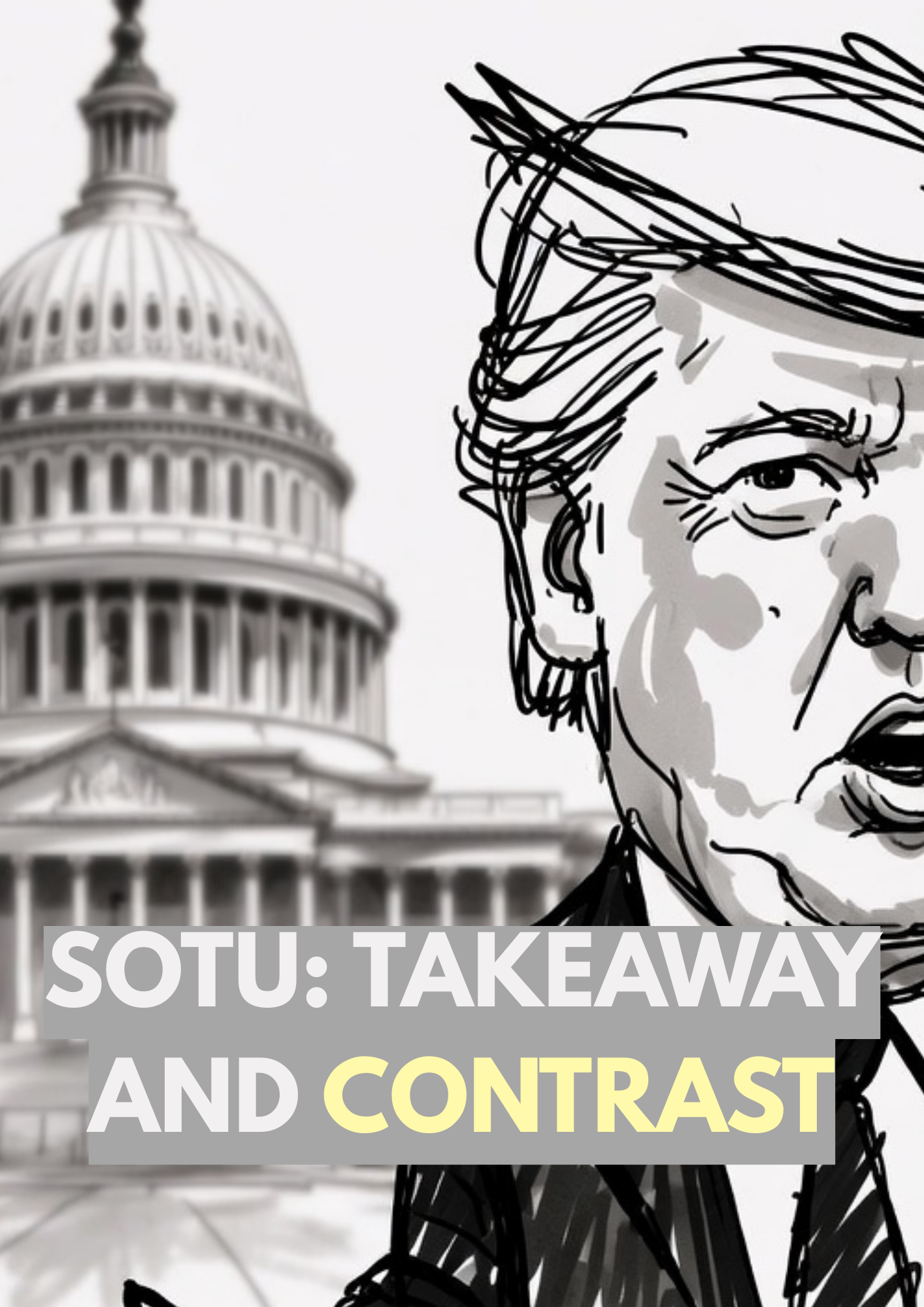
Last night, President Trump clocks in at roughly one hour and forty eight minutes, he delivered the longest State of the Union address in modern history to a divided joint session of Congress. Speaking in his second term, Trump painted his signature vision, the Golden Age of America, a picture of national resurgence: a secure border, a roaring economy, and America "winning" on the world stage after what he called a "turnaround for the ages." It’s fair to say that his speech is classic him, combative, theatrical, and heavy on optimism laced with pointed attacks on Democrats, which we have to point out there are strong oppositions from the Democrats, like Rep Omar, Rep Tlaib, and Rep Jayapal who voiced their oppositions during the speech, and Rep Green carrying a sign in response to the social media post that was now deleted by the President’s team, where former President Obama and First Lady Michelle was mocked in a viral meme
In the official Democratic response, delivered by Virginia Governor Abigail Spanberger offered a sharply contrasting narrative. The newly elected governor, Virginia's first female leader who flipped the statehouse in a landslide, framed Trump's vision as disconnected from the daily struggles of American families. Her rebuttal was concise, pointed, and centered on affordability, safety, and accountability.
Trump's Key Takeaways: "Our Nation Is Back"
Trump's speech was less a laundry list of new proposals and more a victory lap with a midterm sales pitch. He repeatedly declared the U.S. in a "golden age," emphasizing measurable wins while downplaying persistent voter anxieties.
Economy in "Roaring" Form: Trump touted plummeting inflation, record stock market highs, rising incomes, lower gas prices, and a booming manufacturing sector. He credited tariffs and deregulation for the rebound, insisting the country had transformed from crisis to strength in just one year. New ideas included a government-backed $1,000 annual match for retirement savings (targeting the millions without employer 401(k) plans) and calls to bar private equity firms from buying single-family homes. He glossed over broader cost-of-living pressures, instead blaming Democrats for any lingering issues.
Border Security and Immigration Wins: The president highlighted what he called the "strongest and most secure border in American history," with drastically reduced crossings and aggressive deportations of criminal offenders. He shared stories of victims harmed by undocumented immigrants, pushed for "Delilah's Law" (banning commercial driver's licenses for those without legal status), and urged passage of the SAVE Act requiring proof of citizenship to vote. Enforcement was framed as protecting American citizens first.
Global Strength and Domestic Priorities: Trump claimed credit for ending multiple conflicts (including a Gaza ceasefire and actions against Venezuelan leader Nicolás Maduro), pressuring NATO allies, and striking Iranian targets. At home, he called for banning congressional insider trading (drawing bipartisan applause), cracking down on fraud and political violence, and limiting certain medical procedures for minors. The tone turned dark when addressing Democrats, whom he labeled "crazy" for not applauding priorities like protecting citizens over "illegal aliens." The chamber saw walkouts, protests, and at least one ejection (Rep. Al Green).
Overall, Trump's message was unapologetically triumphant: America is bigger, better, richer, and stronger. With midterms looming, he positioned Republicans as the party of results and Democrats as obstacles to continued success.
The Democratic Rebuttal: Governor Abigail Spanberger's Counter-Vision
Spanberger, a former CIA officer and moderate Democrat who won Virginia's governorship by a commanding 15+ point margin in late 2025, delivered the party's official response. Speaking from the House of Burgesses chambers, she structured her remarks around three direct questions to viewers:
"Is the president working to make life more affordable for you and your family? Is the president working to keep us safe at home and abroad? Is the president working for you?"
Her answer to all three: No.
Focus on Everyday Affordability: Spanberger argued that Trump's policies—particularly tariffs—have driven up costs for rent, groceries, healthcare, and energy, estimating an extra $1,700 hit to the average family. She accused the administration of worsening the very problems it claims to solve, ignoring the kitchen-table realities many Americans face.
Critique of Immigration Enforcement and Chaos: She condemned ICE operations in Democratic-led cities as overreach by "poorly trained federal agents" who allegedly detained U.S. citizens without warrants, operated with masked faces to evade accountability, and were linked to the deaths of American citizens in incidents like those in Minneapolis. Spanberger portrayed these actions as sowing fear rather than enhancing safety.
Broader Accusations: Echoing a common Democratic line, she said Trump "lied, scapegoated, and distracted" while offering no real solutions. Republicans in Congress were faulted for enabling him. Sen. Alex Padilla (D-CA) delivered a parallel Spanish-language response reinforcing the affordability and safety themes.
Spanberger's delivery was measured yet blunt—a rising-star platform designed to preview the party's midterm strategy: laser-focus on costs, competence, and compassion over spectacle.
The Stark Contrast: Rosy Resurgence vs. Everyday Reality
The two speeches highlighted the deepening partisan chasm heading into the 2026 midterms.
Trump offered a top-down, achievement-oriented vision: metrics like stock records and border numbers prove success; any pain is either exaggerated or inherited from the prior administration. His style was expansive and defiant, relishing the moment with honors for veterans, athletes, and heroes while calling out opponents in real time. The subtext: Stay the course, and the best is yet to come.
Spanberger countered with a bottom-up perspective: Policies must be judged by their impact on families' wallets and sense of security, not grand claims. Where Trump saw strength and restoration, she saw distraction and division. Her response avoided broad ideological attacks, instead zeroing in on tangible failures—rising costs, chaotic enforcement, unkept promises on affordability.
As the dust settles on this record-breaking night, one thing is clear: The state of the union remains fiercely contested. Americans will ultimately decide in November which vision better reflects their reality—Trump's golden age unfolding or Spanberger's warning of unaddressed struggles. The coming months will test whether optimism or urgency wins the narrative.