On Proportionality
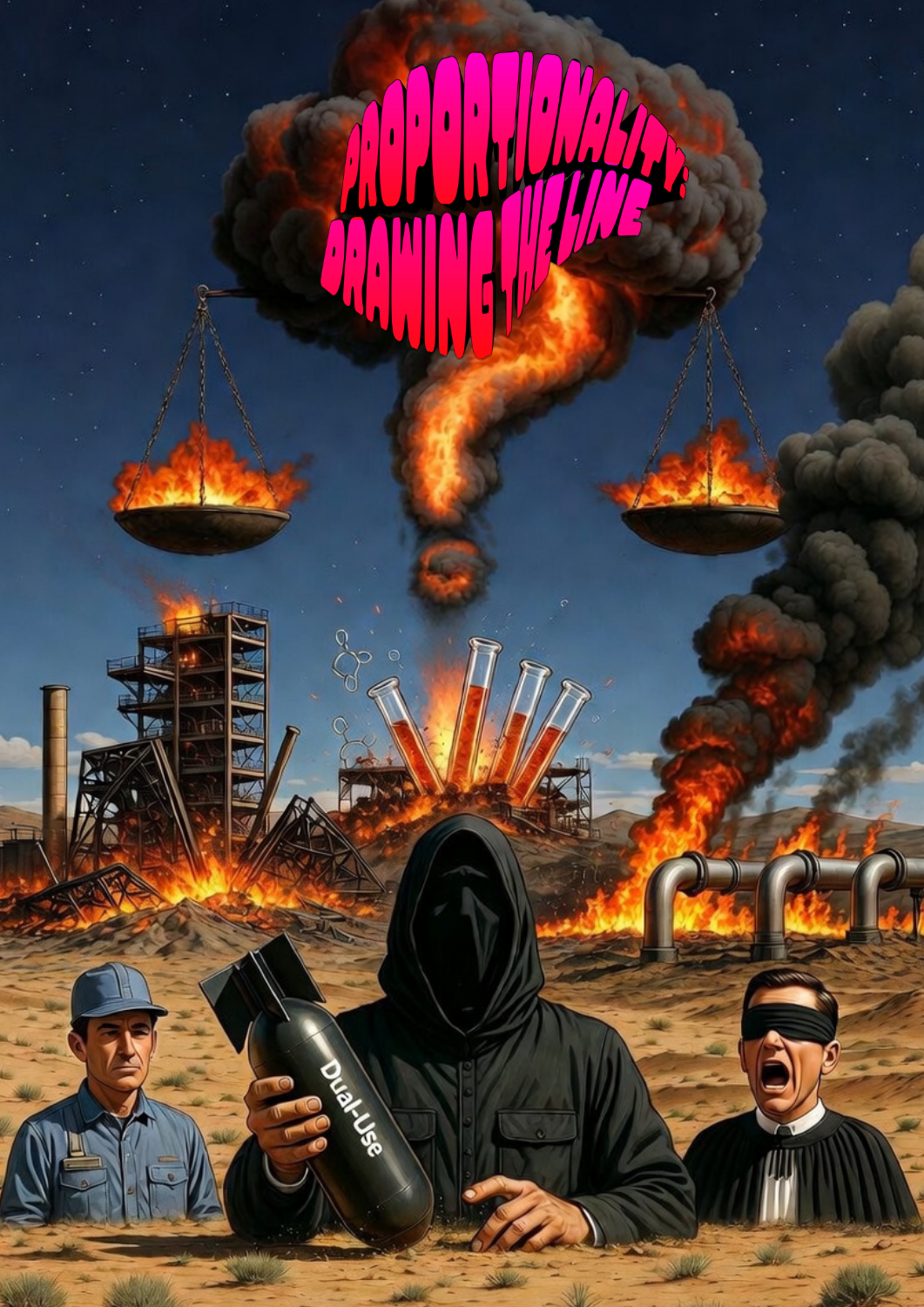
There is a tendency, in moments of crisis, to reduce the law of armed conflict to slogans—invoked, cited, and just as quickly dismissed. Yet the principle of proportionality, codified in Additional Protocol I to the Geneva Conventions, is neither rhetorical ornament nor bureaucratic formality. It is a binding constraint. It requires that anticipated civilian harm not be excessive in relation to the concrete and direct military advantage gained. That standard is not abstract. It is the line that separates lawful military action from collective punishment—and it is the line now under strain in the recent strikes on Iran.
At issue is the nature of the targets themselves. Steel production complexes and pharmaceutical research facilities are, by any conventional reading, dual-use assets: they sustain civilian economies while retaining potential military application. That classification, however, does not grant a blank check. When strikes level factories employing thousands of ordinary Iranians, disrupt power grids that keep hospitals operational, and constrict energy flows that underpin national recovery, the civilian consequences become difficult to relegate to the language of “collateral damage.” Independent reporting already points to rolling blackouts, fractured medical supply chains, and deepening economic contraction in a country whose fiscal outlook was precarious even before the first missile struck.
Within U.S. and Israeli defense circles, a different argument prevails. Proportionality, they contend, is satisfied precisely because these targets contribute to Iran’s war-making capacity. The destruction of major steel facilities does more than impede industrial output; it constrains the logistical backbone of the Islamic Revolutionary Guard Corps. Intelligence leaks further suggest that at least one pharmaceutical site was linked to the production of chemical precursors, placing it—if substantiated—within the category of legitimate military objectives. Energy infrastructure, meanwhile, is framed as a lawful target in a conflict where Iran has itself leveraged oil chokepoints as instruments of coercion. On this view, the strikes are not punitive but preventative: an exercise in self-defense against both kinetic and economic threats.
Yet this reasoning has drawn sharp scrutiny from legal scholars and humanitarian organizations. The International Committee of the Red Cross, alongside several United Nations rapporteurs, has warned that an expansive interpretation of “effective contribution to military action” risks eroding the foundational distinction between civilian and military objects. If nearly any industrial activity can be construed as war-sustaining, then the category of protected civilian infrastructure begins to collapse. Recent history offers cautionary parallels—from the systematic targeting of industrial zones in Syria to the destruction of agricultural and export infrastructure in Ukraine—where similar justifications paved the way for broader campaigns of economic attrition against civilian populations. The strikes in Isfahan may not yet approach that scale, but they test the elasticity of the norm at a moment when international consensus is already fraying. Even among European allies, quiet questions are emerging: is the campaign still calibrated to military necessity, or drifting toward coercive punishment?
Beyond legality lies strategy, and here the calculus grows more uncertain. The sustained degradation of Iran’s industrial and energy base may yield short-term military advantages, but it also risks entrenching long-term instability. A weakened steel sector translates into unemployment and economic dislocation; a damaged pharmaceutical industry into shortages that directly affect public health. Such conditions rarely produce moderation. More often, they incubate grievance. History offers a stark contrast: where postwar reconstruction was prioritized, as in the Marshall Plan, stability followed; where recovery capacity was crippled, resentment and revanchism took root. In today’s networked battlespace—defined by proxy militias, cyber capabilities, and low-cost drone warfare—those grievances do not remain contained. They are weaponized.
None of this absolves Tehran of responsibility. Iran’s own actions—threatening the free flow of commerce through the Strait of Hormuz and launching missile strikes against regional actors—have contributed materially to the escalation. These are not defensive gestures in isolation; they are part of a broader strategy that tests the boundaries of international tolerance. But proportionality is not a ledger in which violations on one side erase obligations on the other. It is a discipline precisely designed to endure in the face of provocation. Retaliation, even when framed as countermeasure, remains bound by law.
The explosions in Baharestan, then, are more than a tactical episode. They are a case study in the moral hazard of modern warfare, where the line between legitimate military targeting and systemic economic harm grows increasingly blurred. Dual-use infrastructure can be lawfully struck. It can also be targeted in ways that are strategically myopic. The distinction hinges on whether the advantage gained is truly concrete and direct—or whether immediate gains are being purchased at the cost of long-term instability.
As the deadline for reopening the Strait approaches and timelines for concluding major operations are publicly floated, the question is no longer confined to the battlefield. It extends to the realm of legitimacy and aftermath. Are these strikes meaningfully degrading Iran’s capacity to wage war today, or are they laying the groundwork for a more volatile and vengeful tomorrow? The answer will not only shape the trajectory of this conflict, but also the credibility of the legal principles invoked to justify it.