On Iran: Senate Fails
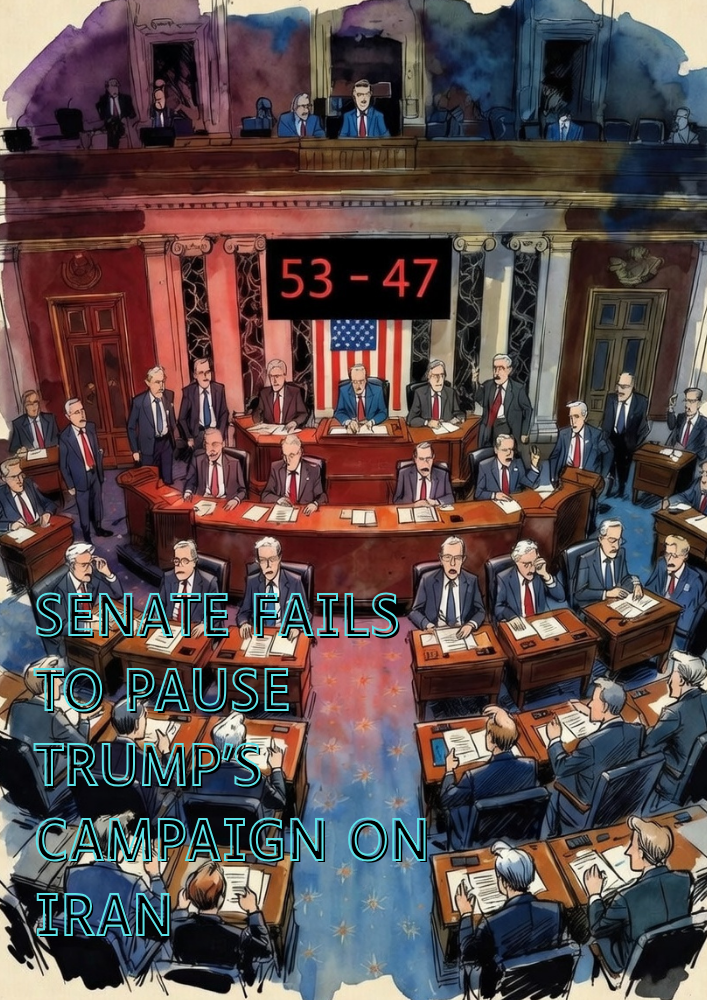
Yesterday, partisan loyalty prevailed over constitutional duty. In a procedural vote, the U.S. Senate rejected a critical war powers resolution by a margin of 53–47, blocking an effort to limit President Donald Trump from pursuing military action against Iran without explicit congressional approval.
The measure, introduced by Tim Kaine of Virginia and backed by 26 co-sponsors, sought to halt ongoing U.S. hostilities with Iran unless authorized by Congress—a fundamental safeguard embedded in America’s founding principles to prevent unchecked executive war-making. Yet in a vote that largely broke along party lines, Senate Republicans—save for the notable exception of Rand Paul of Kentucky—chose to side with the president’s aggressive posture toward Tehran, effectively granting the administration broad latitude to escalate tensions in the Middle East.
From a Democratic perspective, the failure of this resolution represents more than a procedural defeat; it is seen as a troubling abandonment of Congress’s constitutional responsibility. For decades, Democrats have defended the War Powers Resolution as a necessary guardrail against unilateral presidential wars, shaped by the painful lessons of conflicts in Vietnam, Iraq, and Afghanistan. By rejecting this effort, critics argue that Senate Republicans have relinquished their oversight role, allowing the president to pursue military action without the democratic accountability owed to American service members and taxpayers.
Notably, John Fetterman of Pennsylvania broke with many in his party to oppose the resolution. Still, the vote otherwise reflected broad Democratic support for restraining unilateral military escalation and reaffirming congressional authority over decisions of war and peace.
The administration’s approach to Iran has been characterized by escalating rhetoric and renewed military pressure, recalling tensions that peaked during Trump’s first term—including the 2020 killing of Iranian general Qasem Soleimani. Without congressional limits, critics warn that U.S. foreign policy risks becoming increasingly personalized and reactive, driven more by political calculations than by clearly defined strategic objectives.
The consequences of the Senate’s vote could extend far beyond Washington. In the short term, analysts warn that tensions across the Middle East may intensify. Iran and its regional allies could respond through asymmetric attacks targeting U.S. interests—from shipping routes in the Strait of Hormuz to American military installations in Iraq and Syria. Absent legislative constraints, the president could authorize broader strikes, potentially drawing additional regional powers—including Israel and Saudi Arabia—into a wider confrontation.
Economic repercussions are also a concern. Escalating conflict in the Persian Gulf has historically triggered spikes in global oil prices, a scenario that could quickly translate into higher fuel costs and renewed inflationary pressure on American households.
Beyond the immediate risks, the vote raises deeper questions about precedent. If Congress proves unwilling to assert its war powers today, future administrations—Republican or Democratic—may feel emboldened to bypass legislative oversight altogether. Critics argue that such erosion of institutional checks undermines the balance of power at the heart of the American system.
Perhaps most concerning is the human cost. Thousands of U.S. service members remain deployed throughout the region, and any escalation could place them directly in harm’s way. Civilian casualties and instability would likely follow, fueling anti-American sentiment and potentially strengthening extremist recruitment across the region.
For many lawmakers, the debate ultimately extends beyond the specifics of Iran policy. At its core, the failed resolution underscores an enduring question about the limits of presidential authority and the responsibility of Congress to act as a constitutional check. In that sense, the Senate’s vote is not only about the future of U.S. policy toward Iran—it is also about the strength of the democratic institutions designed to govern decisions of war and peace.