Implantables

The Implantable Internet: A Vision of Seamless Connectivity or a Dystopian Dream?
In the ever-evolving landscape of technology, the internet has transformed from a clunky network of dial-up modems and bulky desktops into an omnipresent force woven into the fabric of our daily lives. Today, we access it through smartphones, smartwatches, and even our refrigerators. But what if the next leap forward eliminates the need for devices altogether? Imagine a world where the internet isn't something you hold or wear—it's something implanted directly into your body, accessible through a simple contact lens. This isn't just science fiction; it's a plausible trajectory fueled by advancements in brain-computer interfaces (BCIs), augmented reality (AR), and biotechnology.
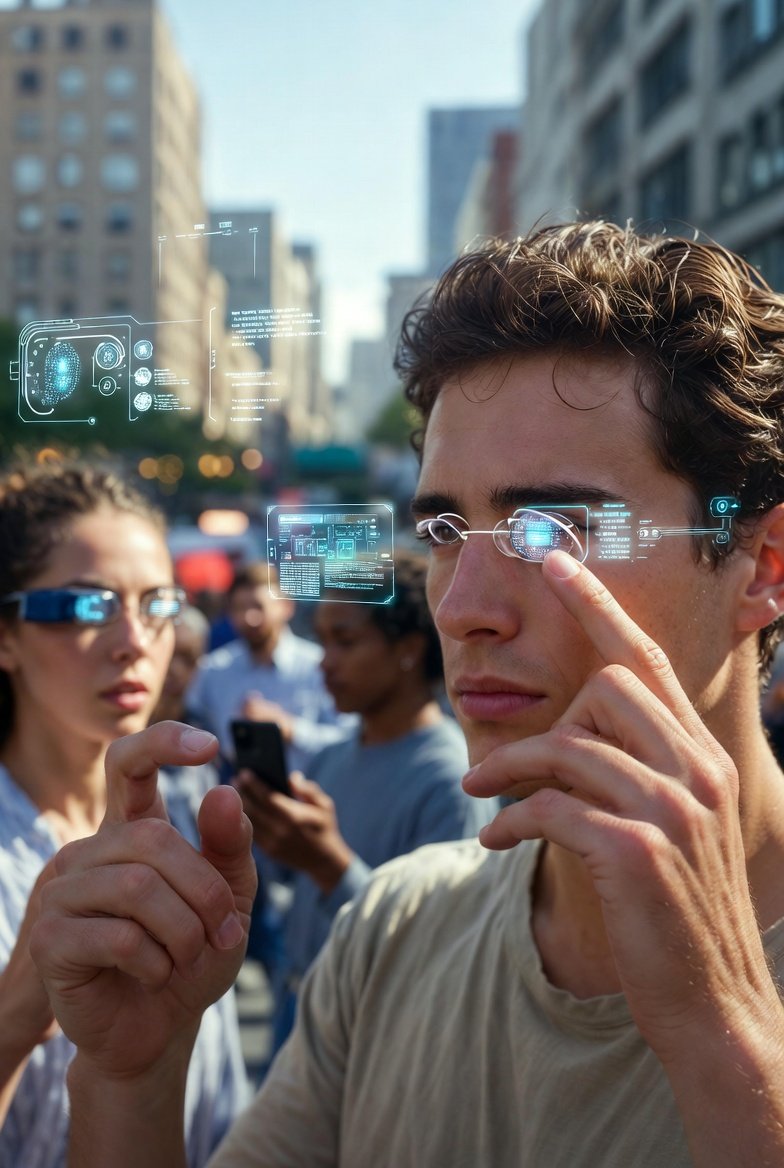
The Rise of Brain-Computer Interfaces: From Sci-Fi to Reality
The foundation for an "implantable internet" already exists in the form of BCIs. Companies like Neuralink, founded by Elon Musk, are pioneering neural implants that connect the human brain directly to computers. These tiny devices, threaded into the brain's cortex, can read and interpret neural signals, allowing users to control cursors, type messages, or even play games with their thoughts alone. As of 2026, Neuralink's first human trials have shown promising results in restoring mobility for paraplegics and enabling basic digital interactions without physical input.
Extending this to the internet isn't a huge stretch. An implanted chip could serve as a gateway to the web, pulling in data streams in real-time. No more scrolling on screens—information would flood your mind as thoughts or visualizations. Search queries could be answered instantaneously, social feeds integrated into your consciousness, and virtual meetings conducted as shared mental spaces. This would represent the ultimate convergence of human cognition and digital networks, blurring the line between biological and artificial intelligence.
But here's where the contact lens comes in as a complementary technology. While the implant handles the backend processing and data integration, a smart contact lens could act as the frontend interface—a visual overlay for the digital world. Prototypes like those from Mojo Vision demonstrate AR contacts that project information directly onto the retina, creating heads-up displays invisible to others. These lenses could display web pages, navigation maps, or augmented realities without obstructing your natural vision. Paired with a brain implant, you'd "see" the internet as an extension of your eyesight, summoning websites or videos with a mere thought.
Possibilities and Potential Benefits
The allure of this setup is undeniable. Accessibility would skyrocket: No more digital divides based on device ownership; the internet becomes as innate as breathing. Education could be revolutionized—students might download knowledge modules directly, accelerating learning. Healthcare applications are equally exciting; real-time health monitoring via implants could predict illnesses, while AR lenses provide surgeons with overlaid diagnostics during operations.
Productivity would explode. Imagine architects visualizing 3D models in their field of view or musicians composing symphonies mentally while walking down the street. Social interactions could evolve too—shared augmented experiences might foster deeper connections, like virtual travel with friends across the globe without leaving home.
From a technical standpoint, the feasibility is growing. Battery life for implants is improving with wireless charging and bio-compatible materials. Data security could leverage quantum encryption, and AI could mediate interactions to prevent information overload. By 2040 or sooner, if trends in miniaturization and neuroscience continue, this could become mainstream, especially as younger generations grow accustomed to integrated tech.
Challenges and Ethical Quandaries
Of course, this vision isn't without pitfalls. Privacy concerns loom large: An implantable internet means constant connectivity, potentially exposing your thoughts to hackers or surveillance. Who owns the data from your neural activity? Governments or corporations could exploit it for control, echoing dystopian narratives from books like Neuromancer or films like The Matrix.
Health risks are another hurdle. Brain implants carry surgical dangers, including infection or rejection, and long-term effects on cognition are unknown. Contact lenses, while less invasive, could cause eye strain or dependency issues. There's also the equity problem: Would this tech be affordable only to the wealthy, widening societal gaps?
Moreover, the psychological impact can't be ignored. Constant access might erode our ability to disconnect, leading to mental health crises. What happens to creativity if every question is instantly answered? Human ingenuity thrives on friction and discovery—removing that could stifle innovation. These are basically just some of the challenges that must be addressed before this new technology gain mainstream acceptance.