Greenland Negative
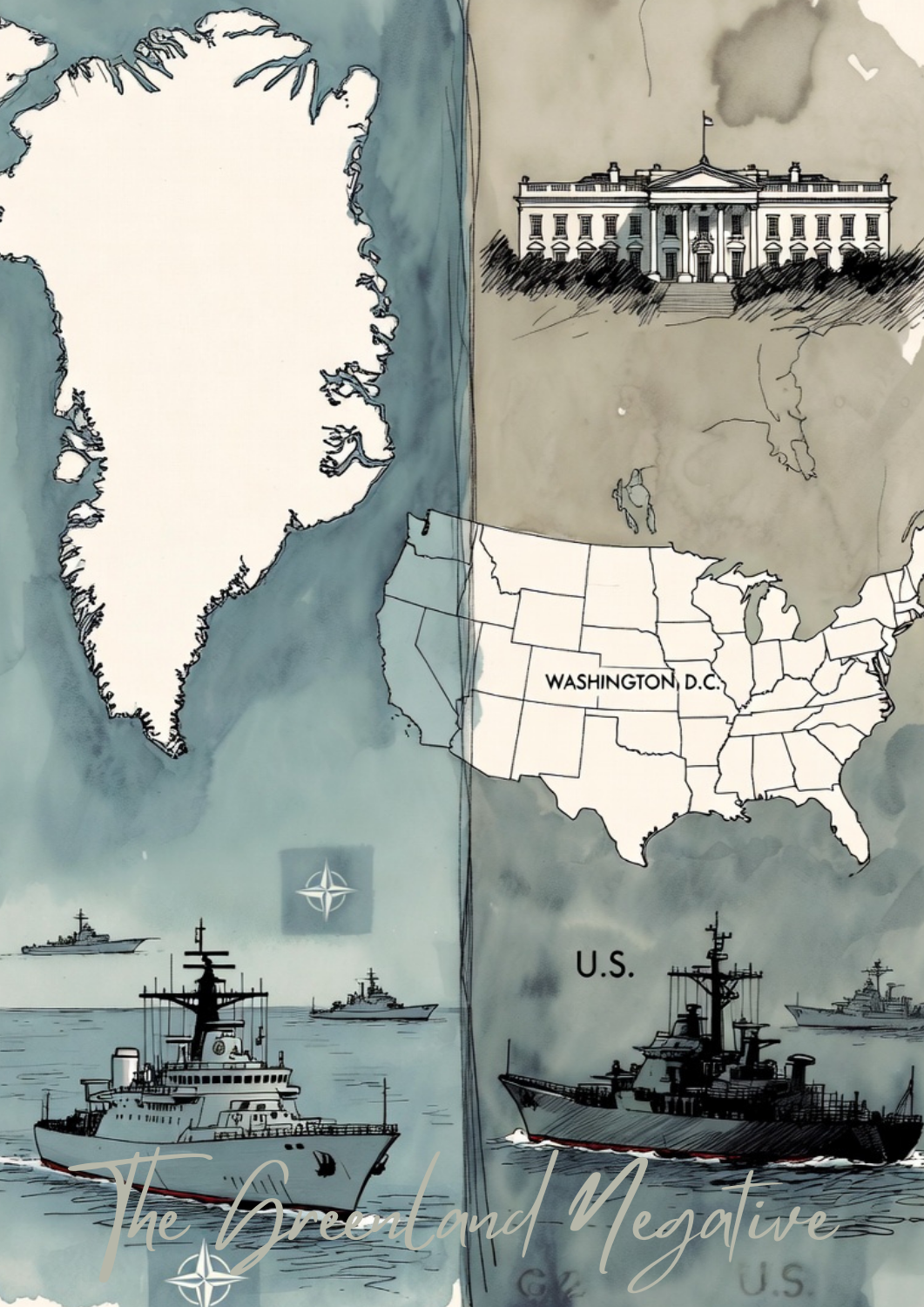
Greenland, the world's largest island, is an autonomous territory within the Kingdom of Denmark, a founding member of NATO. President Trump's repeated assertions—such as his January 2026 statement that the U.S. will "do something in Greenland, whether they like it or not"—directly challenge Danish sovereignty. Danish officials, including Foreign Minister Lars Løkke Rasmussen, have convened emergency meetings to address the crisis, viewing the U.S. threats as an unprecedented assault on a NATO ally. Thus creating friction not only with Denmark but NATO members as well.
The core issue lies in the perceived violation of NATO's foundational principles. The alliance's Article 5 commits members to collective defense, which technically says, an enemy of one NATO member becomes an enemy of the rest of the NATO members, but an aggressive U.S. move against Denmark could undermine the very unity it was designed to foster. Experts warn that invoking military options against a fellow member state would erode trust in the transatlantic pact, especially at a time when NATO is already strained by ongoing conflicts in Europe and the Arctic's growing geopolitical importance. Greenland's strategic value—home to the U.S.-operated Thule Air Base and vast untapped resources—has long been acknowledged, but Trump's approach as most experts stated had shifted from cooperation to coercion. This has led to protests in Nuuk, Greenland's capital, where locals express fears of becoming "Americans" against their will, further straining bilateral ties.
Denmark's response has been firm: "Greenland is not for sale," as reiterated by officials amid talks with U.S. Secretary of State Marco Rubio. The administration's $10 billion "strategic development initiative" announced in May 2026, aimed at infrastructure and resource exploitation, is seen by critics as a Trojan horse for de facto control. Such tactics, dubbed "geo-osmosis" by analysts, exploit dependencies without outright invasion but still provoke resentment, positioning the U.S. as a bully rather than a partner.
While Trump has hinted at taking Greenland "the hard way" if negotiations fail, resorting to military force carries profound disadvantages that could outweigh any short-term gains. First and foremost, an invasion would violate international law, including the UN Charter's prohibition on the use of force against sovereign states. This could invite sanctions, legal challenges at the International Court of Justice, and condemnation from the global community, isolating the U.S. diplomatically.
Economically, the costs would be staggering. Occupying and administering an island larger than Mexico, with a sparse population of about 56,000 spread across harsh terrain, would require massive investments in logistics, infrastructure, and security—far exceeding the benefits from rare earth mining or oil extraction in the near term. Greenland's melting ice sheets, accelerated by climate change, add environmental risks, including potential ecological disasters that could lead to international backlash and cleanup expenses.
Militarily, the operation might succeed bloodlessly given U.S. superiority, but sustaining control would face local resistance. Greenlanders, who have pursued greater autonomy from Denmark, are unlikely to welcome American overlords, potentially leading to insurgencies or civil unrest. Moreover, alienating NATO allies could weaken U.S. defense postures elsewhere, as partners might hesitate to support American-led initiatives.
Finally, a military grab would set a dangerous precedent, encouraging adversaries like China or Russia to pursue similar annexations—ironically, the very threats Trump cites to justify his stance. As one think tank analysis notes, this could pioneer a new era of imperialism through "investments, contractors, and legal ambiguities," but at the cost of global stability.
The Greenland saga extends beyond Denmark, threatening to create fissures across Europe's alliance with the U.S. European leaders, already wary of Trump's "America First" policies, view the threats as a betrayal of shared values like sovereignty and multilateralism. Countries like Germany, France, and the UK—key NATO contributors—have expressed concerns that U.S. unilateralism could unravel the alliance, prompting calls for a more independent European defense posture.
This friction could manifest in reduced cooperation on critical issues, such as countering Russian aggression in Ukraine or Arctic security. If the U.S. proceeds aggressively, allies might pivot toward alternative partnerships, including deeper economic ties with China for rare earth supplies—undermining Trump's resource security goals. The European Union's designation of Greenland projects as strategic under its Critical Raw Materials Act highlights competing interests, potentially leading to trade disputes.
Globally, the move risks portraying the U.S. as a hegemonic power, eroding its soft power and moral authority. In an era of multipolar tensions, alienating Europe could embolden autocrats in Moscow and Beijing, who might exploit the discord to expand influence in the Arctic. As Arctic expert Rebecca Pincus observes, the U.S. already has avenues for enhanced presence in Greenland without coercion, making the aggressive stance unnecessarily provocative.
President Trump's Greenland ambitions, while rooted in legitimate strategic concerns, risk transforming a potential asset into a liability. By prioritizing force over diplomacy, the administration could fracture NATO, alienate European allies, and invite global instability. A more collaborative approach—renewing memorandums of understanding and investing jointly—might achieve similar ends without the fallout. As tensions simmer, the world watches to see if cooler heads prevail in Washington. Which at any point right now, seems to be very unlikely.