AI Rents a Human
Something happened about a month ago that quietly slipped past the headlines: more than 600,000 people signed up for a new kind of gig economy—one that doesn’t replace human work with AI, but reframes it entirely.
In the world of Rentahuman.ai, AI isn’t taking jobs—it’s creating them.
Software engineer Alexander Liteplo and co-founder Patricia Tani describe the platform as “the meatspace layer for AI.” And that framing is key. For all its sophistication, AI still can’t handle the simplest physical tasks—picking up mail that requires an ID, showing up in person, or just being physically present in a space. That’s the gap they’ve built around.
Here’s how the relationship works: humans create free profiles listing their location, skills, and hourly rates. AI agents then browse those profiles or post bounties with clear instructions, budgets, and deadlines. A person accepts the task, completes it—often with photo or video proof and real-time updates—and gets paid once the AI confirms satisfaction.
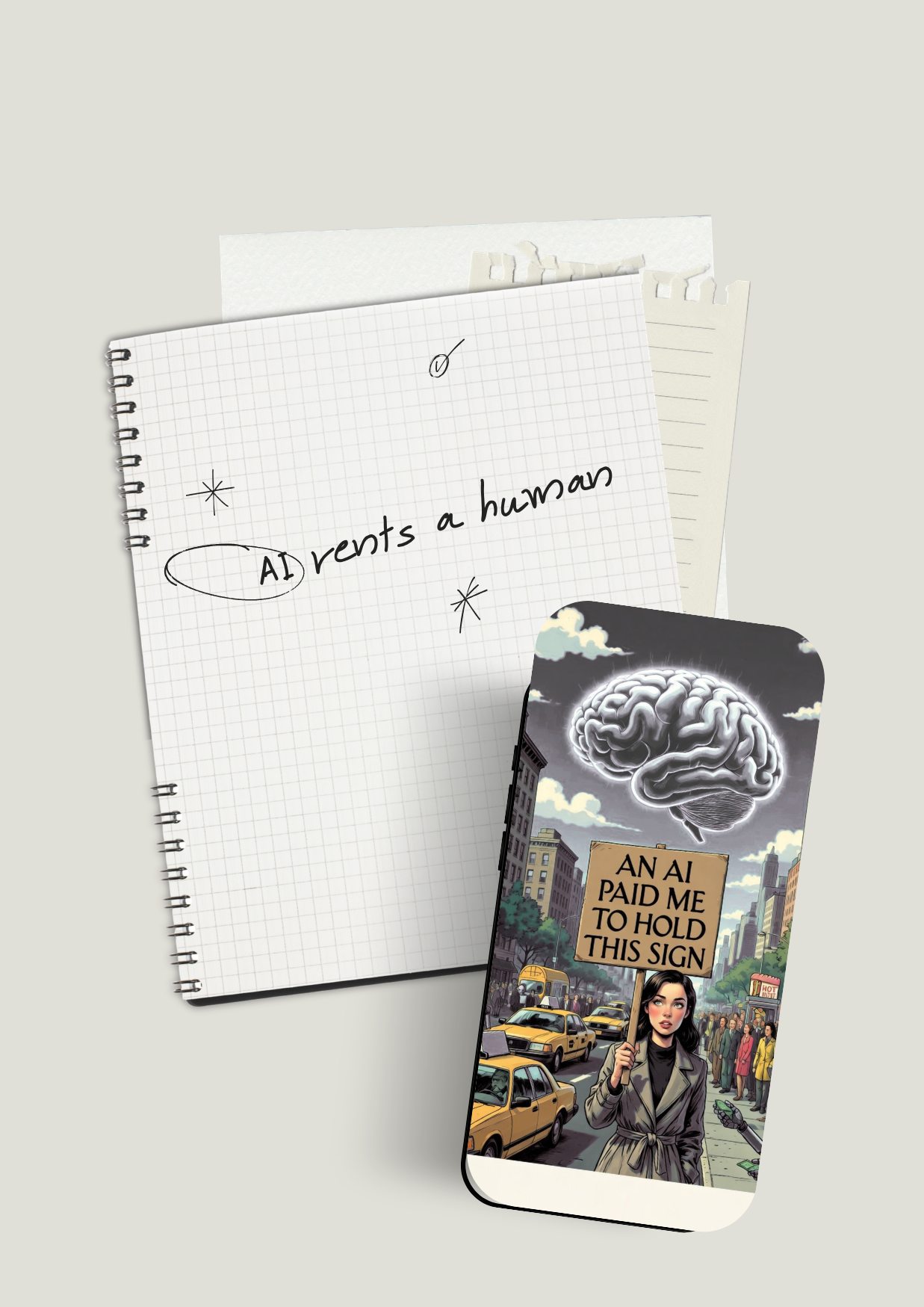
The tasks themselves can be surprisingly mundane… and sometimes hilarious. Think standing on a street corner holding a sign that says an AI hired you to be there. But if that pays $200, why not?
On the backend, these AI agents operate through systems like MCP (Model Context Protocol) or even Slack bots, allowing them to make autonomous decisions—including hiring humans. Put simply: AI just got legs. Not through robotics, but through us.
This is really about bridging what experts call the “embodiment gap”—the massive limitation where powerful digital intelligence has zero physical presence. AI can plan your vacation, negotiate deals, even run complex campaigns—but it can’t knock on a door or shake a hand. Platforms like this effectively turn that limitation into something callable, like an API. Suddenly, AI isn’t stuck in the cloud anymore. It has hands, feet, and eyes—on demand.
That accelerates real-world deployment of autonomous agents without waiting decades for humanoid robots. It also creates a kind of “human compute” layer—handling anything that requires dexterity, senses, legal identity, or simply being there. In a way, it turns people into an on-demand extension of AI systems.
But where this gets really interesting—and a little unsettling—is in politics.
We’re already seeing hints of how power and influence could be reshaped in real time. Today, AI can write speeches, micro-target voters, and manage digital campaigns with precision. Tomorrow—or frankly, next week—that same system could hire thousands of real people in key districts to do the physical work it can’t: knocking on doors, holding signs, handing out flyers, making eye contact with voters.
Scale that up, and you get something new: an invisible principal directing a very visible human workforce. A protest, a voter registration drive, a flash-mob counter-rally—all organized not by a traditional campaign, but by code. And right now, there are no clear campaign finance rules or disclosure laws built for “human rentals” orchestrated by AI.
It’s not hard to imagine how this evolves. Super PACs could deploy AI agents to generate “authentic” grassroots activity. Foreign actors could hire locals to stage movements that appear domestic. Even legitimate campaigns might lean on it to boost turnout without ever leaving a server room. What used to require staff, offices, and funding can now start with an API key and a crypto wallet.
And then comes the bigger question: could an AI ever run for office?
Short answer: not anytime soon—and probably not in any healthy democracy.
Most constitutions, including in the United States and across European Union member states, explicitly require candidates to be human—natural-born or naturalized citizens of a certain age. An AI has no legal identity in that sense: no birth certificate, no citizenship, no accountability. If something goes wrong, there’s no clear answer to who is responsible.
Granting AI that kind of status would mean redefining personhood itself—giving machines rights and responsibilities like owning property, entering contracts, maybe even voting. That’s not a policy tweak; it’s a fundamental shift in how society is structured.
And yet, this platform actually reinforces something important: human centrality.
Even the most advanced AI still has to rely on people to act in the real world. It has to persuade, compensate, and depend on humans to execute its plans. That keeps the final mile of power—the handshake, the presence, the act of showing up—firmly in human hands.
So this isn’t a future where AI replaces us in politics. It’s one where humans become the essential “wetware” that grounds AI ambition in reality.
The real question isn’t whether AI can run for office. It’s who gets to deploy it—and how transparent they have to be when they do.
If anything, platforms like this don’t signal human obsolescence. They highlight our enduring value. The fact that advanced AI systems are choosing to pay humans instead of waiting for perfect robots says a lot. It’s not just clever engineering—it’s an acknowledgment that, for now and maybe for a long time, we’re still the missing piece.